Spotlight Summary
Profile Overview
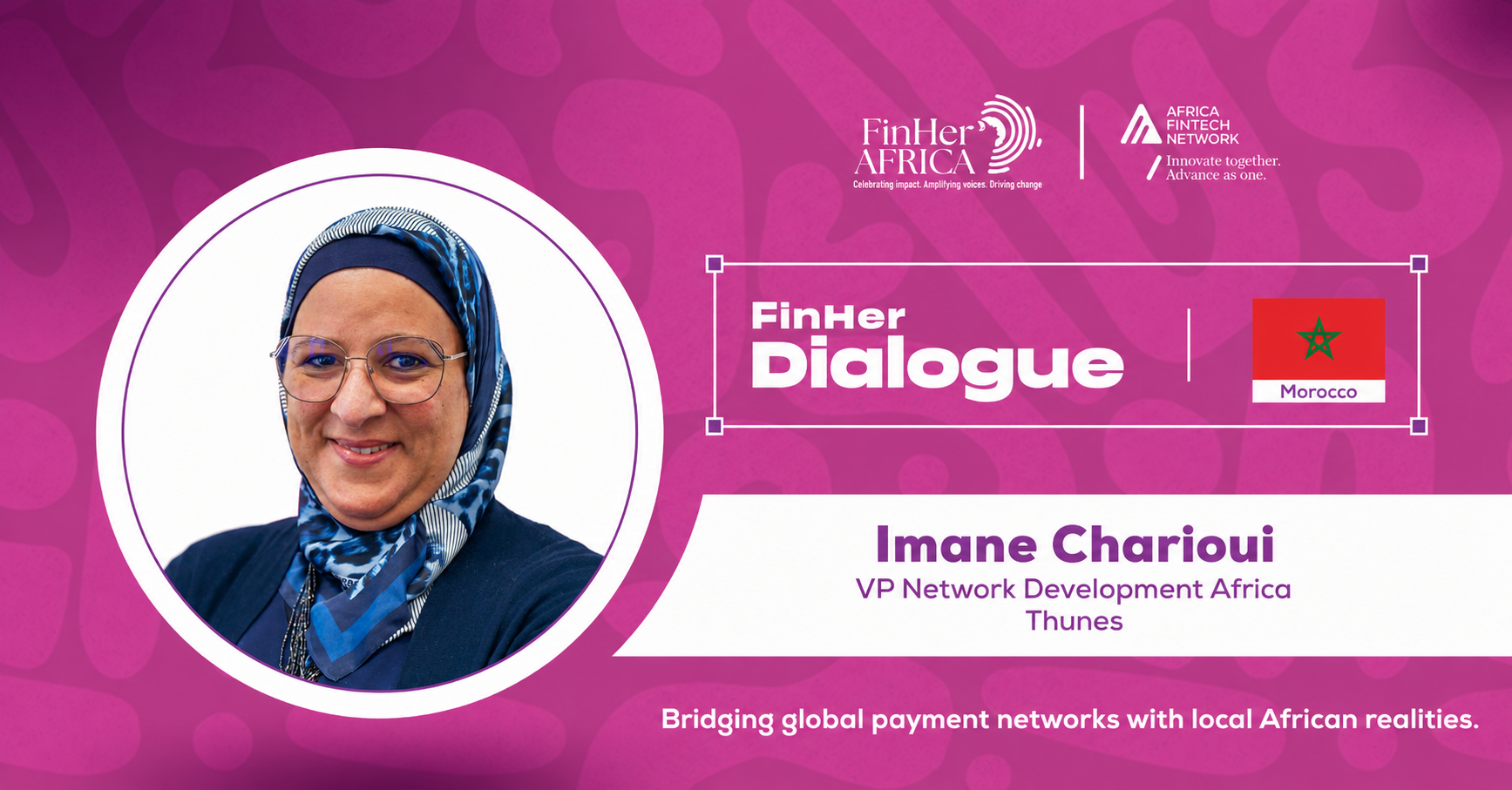
Imane is a seasoned fintech and payments executive with over 20 years of experience spanning remittances, foreign exchange, business development, and financial inclusion across Africa and other emerging markets. She currently serves as VP Network Development Africa at Thunes, where she leads the expansion of partner networks across the continent, from West Africa to Central and North Africa enabling scalable, reliable, and seamless cross-border payment flows.
A passionate advocate for African payments infrastructure, Imane has held senior positions at globally recognized financial institutions, driving the deployment of mobile banking solutions and digital wallets designed around the realities of African consumers and markets.
Throughout her career, her work has sat at the intersection of global payment systems and local market dynamics, consistently focused on building high-value partnerships, deepening financial access, and accelerating innovation across Africa’s fast-evolving fintech ecosystem. Outside of work, she is committed to mentoring the next generation of entrepreneurs and advancing financial literacy across the continent.
Her Experience Summary
- VP Network Development Africa – Thunes (Current)
- Head of Francophone Africa & Middle East – Business Development & FX – Zepz (WorldRemit & Sendwave)
- Head of Middle East, North & Central Africa – WorldRemit
- Western Union –
- Financial Analyst
- Senior Financial Analyst – Africa & Middle East
- Business Development Lead – Madagascar
- Regional Finance Head – Africa
Q- Could you briefly share how your career led you into fintech?
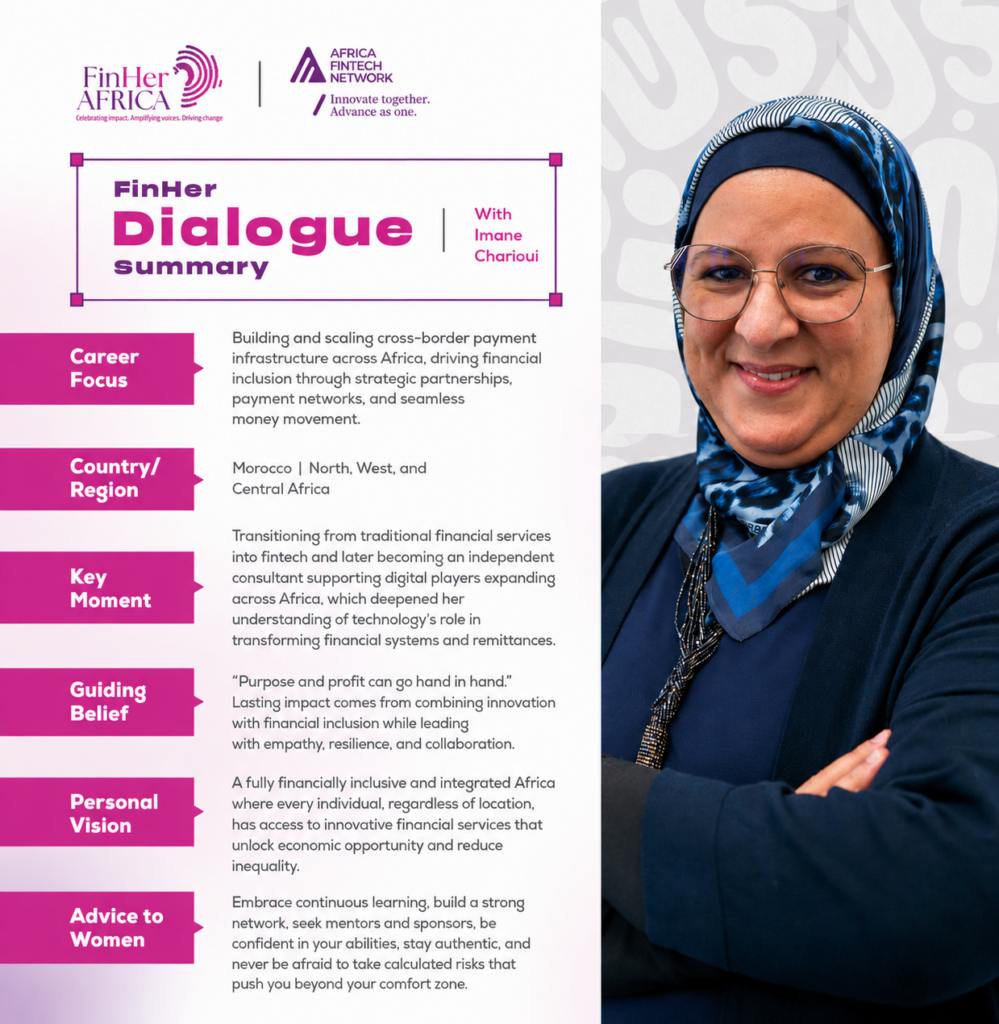
A- My path into fintech was not linear, it was a deliberate, layered evolution shaped by curiosity, conviction, and a growing sense of purpose.
I began in traditional financial services, grounded in financial analysis and FP&A. That foundation gave me something invaluable: an intimate understanding of how money actually moves, and more importantly, who gets left behind when it doesn’t move well. The remittance industry, with all its social weight, became my entry point into understanding financial exclusion as a structural problem, not just a market gap.
From there, I made a conscious effort to expand beyond the numbers. I immersed myself in compliance, legal, operations, and commercial strategy, because I understood early that to solve complex problems, you need to speak multiple languages within a business. That breadth eventually pushed me toward business development and partnerships, the work of actually building solutions, not just analyzing them.
A genuine turning point came when I stepped into independent consulting, supporting digital players in establishing and scaling their presence across Africa. That experience accelerated everything. It forced me to think like a builder, engage with regulators, and understand the full ecosystem, not from the inside of one organization, but across many.
Over the past two decades, I have invested deliberately in my network across the regional tech, regulatory, and finance communities, attending key industry events, seeking out mentors who are leaders in the field, and staying close to the frontier of what is changing. What this journey has taught me is that fintech rewards those who combine domain depth with intellectual humility. You do not need a traditional finance or computer science background to thrive here. What you need is a relentless willingness to learn, a clear-eyed view of the problem you are solving, and genuine commitment to the people your work is meant to serve.
Q: What does your current role entail, and what excites you most about it?
A: I am VP Network Africa at Thunes, a role that sits at the heart of how money moves across the continent and beyond.
Thunes is a global cross-border payments infrastructure company, and in this position, I lead alongside a talented and dedicated team, the development and expansion of the partner network that powers cross-border payment flows across Africa, from mobile money operators and banks to fintechs and MTOs.
What makes this role genuinely exciting is the infrastructure layer it operates on. It’s not just about moving money; it’s about building the rails that others rely on in a market that is evolving faster than anywhere else in the world.
I navigate:
- A complex, fragmented market where no two corridors are alike, each with its own regulatory framework, liquidity dynamics, and dominant payout rails.
- Strategic partnership development across a continent that is leapfrogging traditional financial systems.
- The intersection of global payments and African market realities, bridging what global players need with what local ecosystems can deliver.
But beyond the business, this work carries real human impact. Every partnership we build, every corridor we open, and every payout rail we activate translates into something tangible for real people: a mother in Dakar receiving money from her son in Paris, a small trader in Nairobi settling a cross-border transaction, or a family in Abidjan accessing remittances that represent a lifeline to their household income.
At its core, this work advances financial inclusion across a continent where millions remain underserved by traditional banking systems, expanding access to financial services and enabling local businesses to participate in regional and global trade.
It requires equal parts strategic vision, relationship depth, and regulatory fluency. And knowing that behind every transaction there is a person whose financial life we are making a little easier, that, at scale, is what truly drives me.
Q- What professional milestones or achievements are you most proud of?
A- I’m most proud of milestones that combined innovative business solutions with tangible social impact, demonstrating that purpose and profit can go hand in hand in the fintech world.— where doing good and doing well were not in tension, but mutually reinforcing.
Two stand out.
The first is having successfully introduced leading digital payment brands into markets where they filled a genuine void- delivering fair, transparent, and efficient services to communities that had been systematically underserved by traditional financial infrastructure. Seeing those brands take root and grow in environments that required real market-building, not just sales execution, remains a source of deep professional pride.
The second is the work of navigating and harmonizing operations across highly diverse regulatory landscapes. Designing frameworks that satisfy multiple, sometimes conflicting, regulatory requirements while maintaining business continuity and enabling growth is not glamorous work, but it is foundational. Getting that right, repeatedly, across different markets and regulatory regimes, is the kind of achievement that does not always make headlines but creates lasting institutional value.
Q- As a woman in fintech, what challenges have you faced and how did you navigate them? What lessons did those experiences teach you?
A- The challenges are real, and I think it does the conversation a disservice to soften them.
The first is gender bias- pervasive, often subtle, and persistent. Women in fintech are routinely held to higher standards than their male peers, scrutinized more closely, and more frequently required to prove credibility that is simply assumed for others. I have been the only woman in many rooms throughout my career. That experience sharpens your instincts, but it should not be a prerequisite for advancement.
The second is the absence of representation at senior levels. Only around 20% of executive roles in fintech are held by women, with even fewer at the founder level. That scarcity has a compounding effect, it limits the visibility of role models, reduces access to sponsors who can open doors, and quietly narrows the sense of what is possible for women earlier in their careers.
Navigating both required me to be deliberate. I invested in building a strong network, sought out mentors and sponsors proactively, and chose my environments carefully, prioritizing organizations where my work could speak for itself. The lesson, ultimately, is that resilience is necessary but insufficient. Structural change is what actually moves the needle.
Q- What do you see as the biggest opportunity for fintech in Africa right now? And what is one challenge we need to overcome as an ecosystem?
A- The biggest opportunity is also the most obvious one, and yet it remains largely underexploited: financial and digital inclusion at scale. More than half of Africa’s population remains unbanked, which represents not just a market opportunity but a structural imperative. Fintechs are uniquely positioned to close that gap; leveraging mobile penetration rates that have already outpaced formal banking infrastructure, and delivering accessible, affordable solutions precisely where traditional systems have failed to reach.
The challenge that constrains nearly everything else is regulatory fragmentation. Fifty-four countries, fifty-four central banks, fifty-four sets of licensing requirements and compliance standards, operating across even a handful of African markets requires navigating a level of complexity that few global players are genuinely prepared for. Until there is meaningful progress toward harmonized frameworks, or at the very least, greater mutual recognition across regions, the cost and friction of cross-border fintech will remain a barrier to the scale this continent deserves.
Q- How do you see the fintech landscape in North and Francophone Africa evolving differently from the rest of the continent, and what unique opportunities do you think are being overlooked?
A- North and Francophone Africa are consistently underestimated, and that is exactly where the opportunity lies.
In North Africa, markets like Morocco and Egypt are moving beyond basic digitization toward more sophisticated infrastructure; open banking, regulatory sandboxes, and growing ambitions as bridges between Europe, the Gulf, and Sub-Saharan Africa. That positioning is real and still largely untapped by global players.
In Francophone West and Central Africa, mobile money penetration is deep, but the interoperability layer, cross-border infrastructure, and formal financial services sitting on top of that base remain underdeveloped. That gap is where the next wave of fintech opportunity lives.
What is being overlooked? The francophone corridor is still too expensive relative to demand. The BCEAO regulatory framework rewards patient, well-structured players, but few take the time to engage with it seriously. And North Africa’s role as a strategic bridge for African, European, and Gulf payment flows has barely been explored.
The operators who understand these markets on their own terms, rather than through an anglophone lens will find less competition and more durable returns.
Q- Who or what has inspired you along the way? What leadership lesson has shaped how you approach your work?
A- My inspiration comes from two distinct but connected sources: the pioneers who built paths where none existed, and the people whose lives are genuinely changed when financial systems work for them.
Among the leaders who have shaped my thinking, I draw inspiration from women who have built with conviction in difficult environments: Valérie Neim, Founder and CEO of Brazza Transactions; Odunayo Eweniyi, Co-founder and COO of PiggyVest; and Ruth Iselema, Co-founder and CEO of Bitmama. Their trajectories are a testament to what is possible when technical excellence meets purpose-driven leadership.
But my deepest motivation comes from witnessing impact at the individual level- a family receiving a transfer that covers school fees, a small business owner accessing working capital for the first time. At scale, those moments represent a different kind of infrastructure: the infrastructure of economic dignity.
The leadership lesson that has shaped me most profoundly is this: speed and authority are not the same thing as leadership. The fintech industry rewards velocity, and the temptation to make fast, top-down decisions is constant. But I have learned that leading with genuine empathy, taking the time to understand what people need, what drives them, and what stands in their way, produces decisions that are more robust, teams that are more resilient, and outcomes that actually last. The strongest leadership I have encountered, and the kind I aspire to, draws its power not from hierarchy but from the collective intelligence of a diverse, supported, and genuinely empowered team.
Q- How do you balance personal life, family, leadership, and professional demands?
A- My family is not a context for my career, it is the foundation of everything I do. I am a wife and a mother of three, and that reality shapes how I lead, how I prioritize, and how I define success.
I am deeply conscious of the example I set, particularly for my daughter. The idea that how we live our values matters as much as what we say we believe in, that shapes the choices I make every day, professionally and personally.
I am also deliberate about the environments I choose to work in. I prioritize organizations with genuine commitments to psychological safety and employee well-being, not as perks, but as organizational philosophy. That standard has guided some of the most important decisions of my career.
On the practical side, I rely on intentional time-blocking, protecting time for focused work, for family, and for personal restoration with the same discipline I apply to professional commitments. I have also learned, over time, to say no clearly and without apology to commitments that do not align with my core priorities. Balance is not a fixed state, it is a practice, and one that requires constant recalibration. But the investment is worth it.
Q- Do you have a personal mantra, quote, or saying that inspires you and could inspire others?
A- One quote has stayed with me across every chapter of my career- a reflection on resilience from King Hassan II of Morocco:
“The battles of life are not won by the strongest, nor by the fastest, but by those who never give up.”
In an industry that rewards speed and scale, this is a grounding reminder. Endurance, consistency, and the refusal to be deterred, these are the qualities that ultimately define careers, and impact.
Q- From your experience, what structural changes (within companies or across the ecosystem) would make it easier for more women to rise into leadership positions in fintech across Africa?
A- Mentorship panels and visibility programs are not enough. The barriers are structural and require structural responses.
Three things would move the needle:
– Redefine performance criteria. Availability, after-hours networking, a particular style of assertiveness, these proxies systematically disadvantage women. Results-based evaluation opens doors that are quietly closed today.
-Invest at the mid-career inflection point. The pipeline doesn’t empty at the entry level, it empties in the middle. Structured sponsorship and genuine flexibility at that stage retain the talent that others lose.
-Fund women-led businesses. Access to capital shapes who builds companies, and who builds companies shapes who leads across the ecosystem. The opportunity is there, investors who act on it will access a pipeline others are ignoring.
Leadership follows when conditions are fair, not when they are perfect.
Q- What advice would you give to young women or professionals aspiring to build careers in fintech?
A- Invest in continuous learning, not as a one-time credential, but as a permanent practice. Fintech is defined by change, and the professionals who thrive are those who stay intellectually curious and technically fluent across multiple domains.
Seek out mentors who challenge you, sponsors who advocate for you, and peers who push you forward. Invest in your digital presence. Show up where your industry converges.
Develop your voice and use it. Confidence is not a personality trait, it is a skill you build through action. Speak up in rooms where your perspective is underrepresented. Your point of view has value, and the field is better when you contribute it.
Be uncompromisingly yourself. Authenticity is not softness, it is precision. Knowing who you are and what you stand for makes you a clearer thinker, a more credible partner, and a more effective leader.
And take the risk. Not recklessly, but deliberately. The opportunities that have shaped my career most profoundly were the ones that made me uncomfortable first. Lean into that discomfort. Learn from what doesn’t work. And keep building.
Q- What vision do you hold for the future of fintech in Africa? What legacy do you hope to leave in this ecosystem?
A- My vision is of an Africa that is fully financially integrated, where every individual, regardless of geography, income level, or background, has meaningful access to financial services that expand their economic agency and reduce systemic inequality. Not a future built on exclusion with a digital veneer over it, but one where the architecture of finance is genuinely democratic and genuinely resilient.
The legacy I hope to leave is twofold.
The first is impact at scale- measurable, honest impact on the number of people whose financial lives are materially improved by the infrastructure and partnerships I helped build. Market share matters, but it is a proxy. The real measure is lives changed.
The second is the ecosystem itself. I want to leave it more inclusive, more interconnected, and more globally competitive than I found it, with more women in leadership, more African voices shaping global payment standards, and a generation of builders who see the continent not as an emerging market to be served, but as a global force to be reckoned with.Imane Charioui – VP Network Development Africa – Thunes