Spotlight Summary
Profile Summary
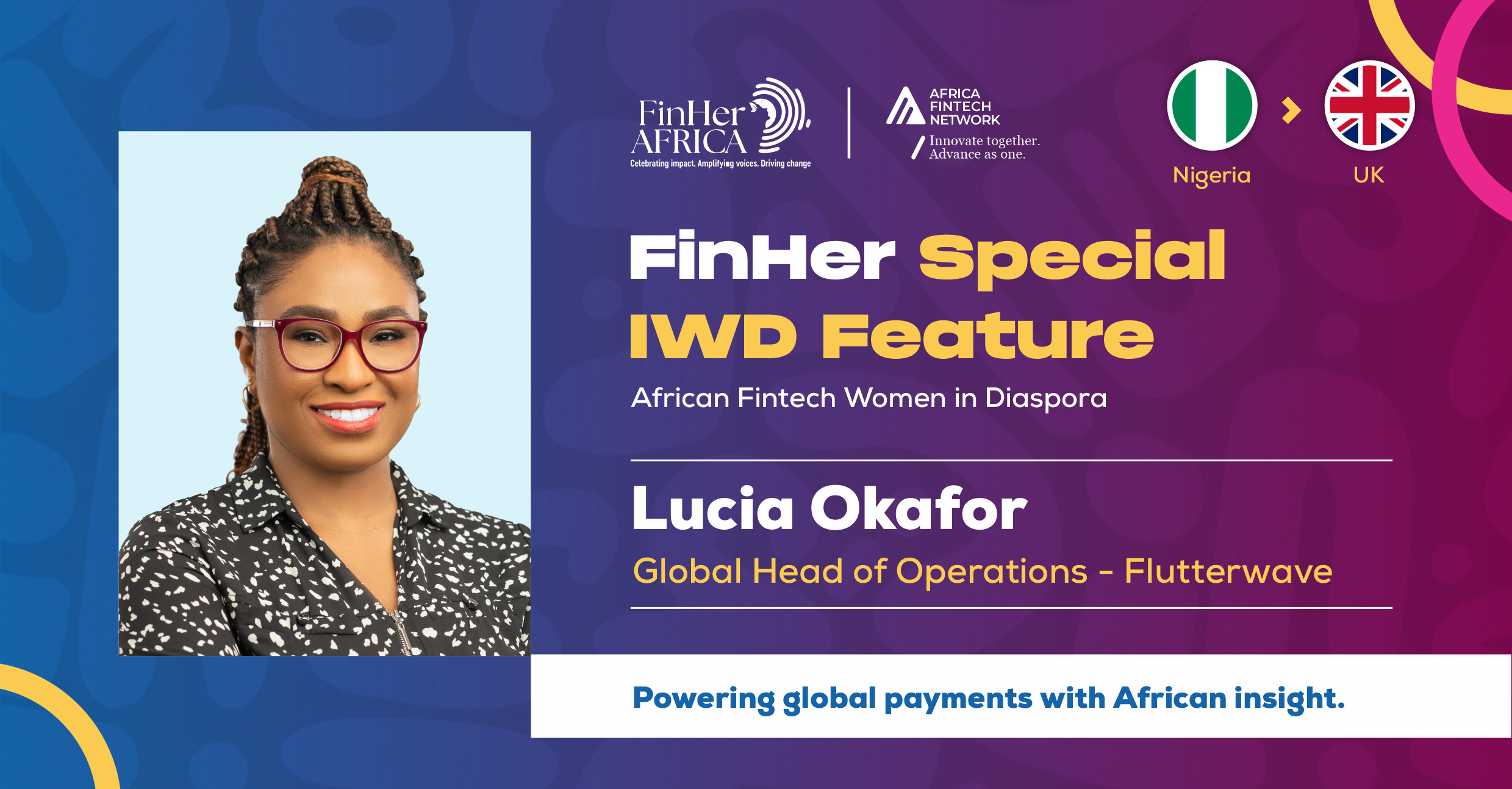
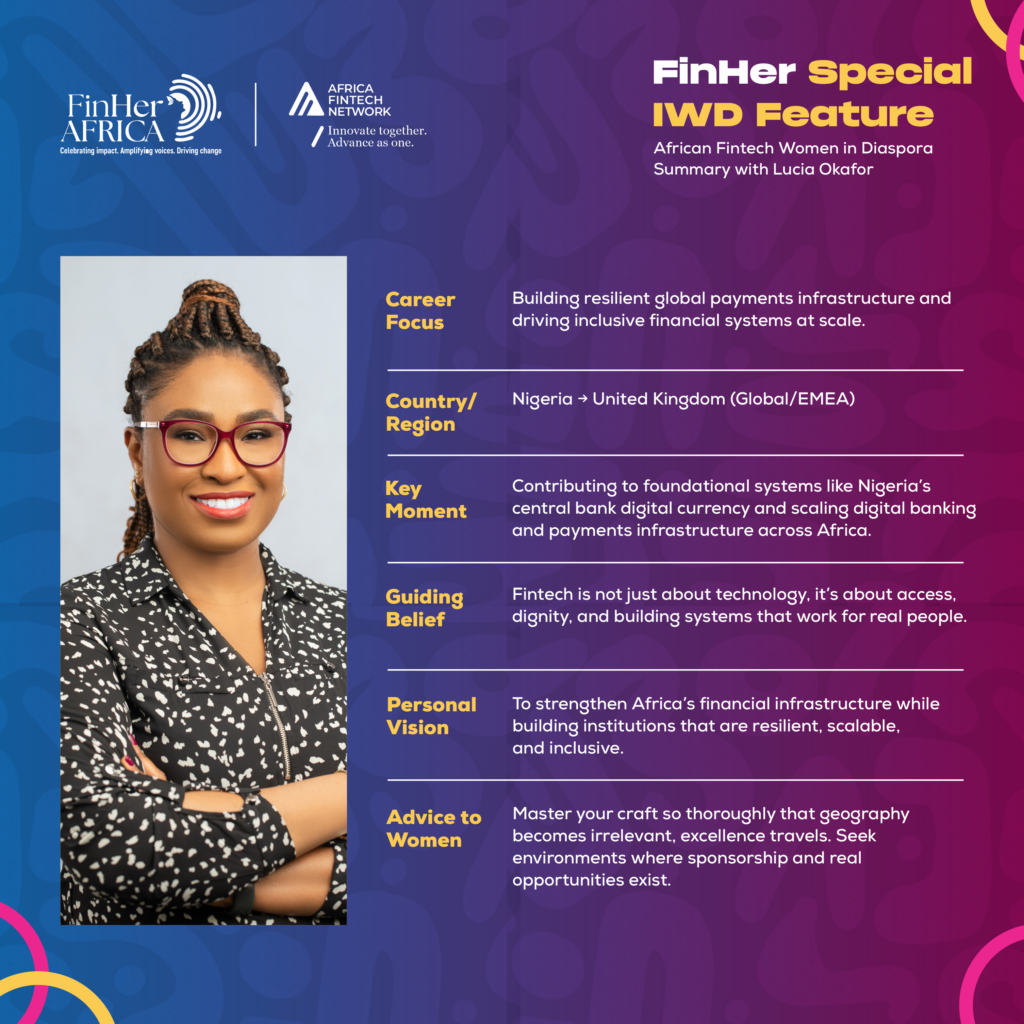
Lucia Okafor is a fintech and payments leader from Nigeria, currently based in the United Kingdom, operating at the intersection of global financial systems and African market realities. She focuses on building resilient, scalable, and inclusive payments infrastructure that powers businesses, economies, and everyday transactions across borders.
Her work spans strategy, operations, and large-scale transformation, with a strong emphasis on reliability, access, and system-wide impact across global and African financial ecosystems.
Her experience includes:
- Global Head of Operations (Current) – Flutterwave
- Senior Manager, Banking & Payments Strategy – Deloitte UK
- Senior Manager, Payments Strategy & Digital Transformation – PwC Strategy& South Africa
- Senior Manager – Strategy (Financial Services & Payments) – PwC Nigeria
- Head, e-Business & Income Optimization – Zenith Bank
- Consultant, Strategy (Financial Services) – PwC
1. Journey & Identity
Could you briefly share your journey into fintech and how your African roots have shaped the way you lead and build in global ecosystems?
My journey into fintech started on the ground in Nigeria, where I experienced firsthand how fragile financial systems can exclude millions of people, payments failing, identities unverifiable, and small businesses operating outside the formal economy. These weren’t theoretical issues but daily realities.
Growing up and starting my career in that environment shaped how I lead today. It taught me that innovation must be practical, inclusive, and resilient. As I often say, “fintech has never been about technology alone, it’s about access and dignity.”
Across roles at PwC, Deloitte, Zenith Bank, and now at Flutterwave, I’ve stayed focused on one question: how do we build systems that work for real people at scale? “My African roots remain my compass; they keep my mission grounded and practical.”
2. Women in Fintech
What unique challenges do African women in fintech, especially in the diaspora, continue to face?
African women in fintech, particularly in the diaspora, often navigate multiple barriers; gender bias, geographic distance from home markets, and the constant expectation to “prove” competence. Opportunities don’t always come naturally; they have to be fought for.
What made the difference for me was sponsorship: leaders who trusted me with significant mandates and put my name forward in rooms I wasn’t in.
Mentorship is helpful, but sponsorship changes trajectories. We need more of it, intentionally. We also need more capital directed at female founders and stronger networks that make opportunity visible.
3. International Women’s Day Reflection
What does meaningful progress for women in fintech look like?
Meaningful progress means women with real influence, not just representation. It’s women leading P&Ls, shaping strategy and policy, allocating capital, and building companies.
It’s equity in ownership and influence, not just seats at the table. As leaders, our responsibility is to make the path less exceptional and more accessible.
We need to sponsor, advocate intentionally, challenge biased systems, and design environments where success doesn’t depend on extraordinary resilience. Progress comes from intention and action, not by accident.
4. Bridging Ecosystems
Where do you see the biggest opportunities for collaboration between Africa-based fintechs and global institutions?
The biggest opportunity today is partnership and infrastructure collaboration. African fintechs bring speed, creativity, and proximity to customers. Global institutions bring capital, trust, and scale.
Together, we can solve the hard infrastructure problems, seamless cross-border payments, remittance corridors that actually work, and digital identity frameworks that unlock inclusion, that no single player can tackle alone.
The future isn’t Africa catching up; it’s co-creating the next generation of financial systems.
5. Working in the Diaspora
What has it been like building a fintech career in the diaspora while staying deeply connected to Africa’s ecosystem?
Operating between Africa and global markets has given me a dual lens. From the diaspora, you gain exposure to capital markets, world-class standards, and the discipline required to scale globally. From Africa, you learn speed, resilience, how to innovate without legacy infrastructure, and how to thrive on adaptability.
Perspective gives me the ability to connect what others see as separate. And that is exactly where meaningful impact happens: advocating for Africa’s potential while helping local ecosystems meet global standards to unlock growth.
6. Impact & Vision
What impact are you most proud of?
I’m most proud of work that creates systemic change. Launching Nigeria’s central bank digital currency, helping shape South Africa’s digital identity infrastructure, scaling digital banking across West Africa, and now strengthening Africa’s payments infrastructure are some of my proudest achievements.
These are foundations that millions of people interact with daily. At Flutterwave, my focus is ensuring our operations can support half a million daily transactions reliably and securely.
“When payments work seamlessly, people don’t notice, but that invisible impact matters deeply to me.”
7. Leadership & Influence
How would you describe your leadership style today?
My leadership style is systems-driven and people-centred. Early in my career, leadership felt like having all the answers. Today, it’s about creating clarity, building strong teams, and creating environments where others can excel and institutions outlast individuals.
In payments and operations, reliability is everything. If the system works seamlessly and consistently, we’ve succeeded. “My job isn’t to be the smartest person in the room, it’s to make sure the room works.” I focus on sustainable outcomes over quick wins.
8. Advice & Legacy
What advice would you give, and what legacy do you hope to leave?
If, years from now, people say I helped strengthen Africa’s financial infrastructure, built resilient institutions, and made the ecosystem more inclusive for the women coming behind me, that would be a legacy I’m proud of.